Page 1 of 1

PostPosted: Wed Sep 24, 2008 4:04 pm
by kiwibarguy
THE TALE OF THE ARAB FLIGHT CREW
Written by To The Point News
Friday, 29 August 2008

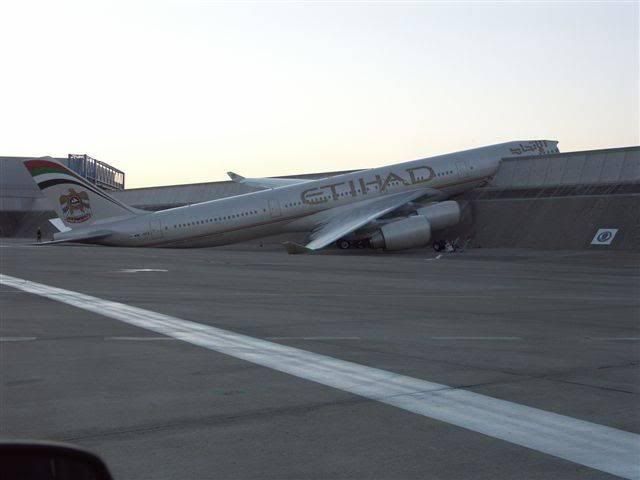
The brand spanking new Airbus 340-600, the largest passenger aeroplane ever built, sat in its hangar in Toulouse, France without a single hour of airtime. Enter the Arab flight crew of Abu Dhabi Aircraft Technologies (ADAT) to conduct pre-delivery tests on the ground, such as engine runups, prior to delivery to Etihad Airways in Abu Dhabi. The ADAT crew taxied the A340-600 to the run-up area.

Then they took all four engines to takeoff power with a virtually empty aircraft. Not having read the run-up manuals, they had no clue just how light an empty A340-600 really is. The takeoff warning horn was blaring away in the cockpit because they had all 4 engines at full power.

The aircraft computers thought they were trying to takeoff but it had not been configured properly (flaps/slats, etc.) Then one of the ADAT crew decided to pull the circuit breaker on the Ground Proximity Sensor to silence the alarm. This fools the aircraft into thinking it is in the air. The computers automatically released all the brakes and set the aircraft rocketing forward.

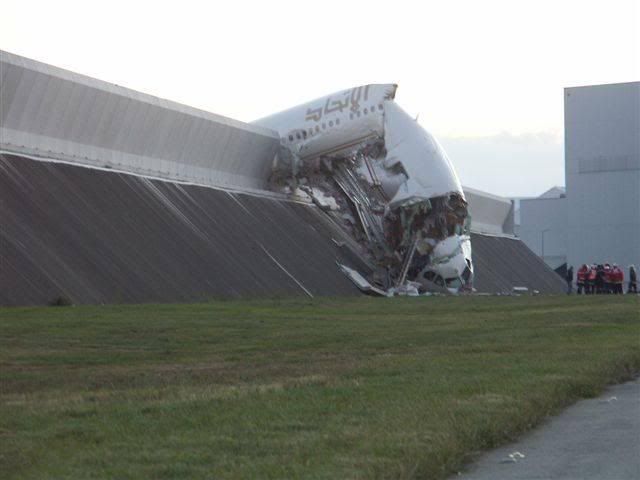
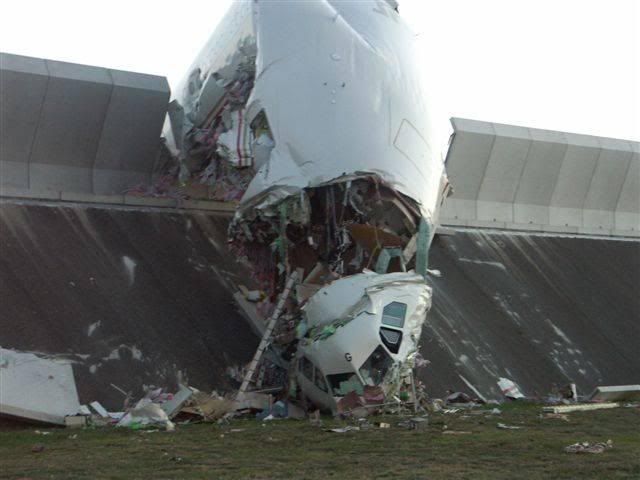
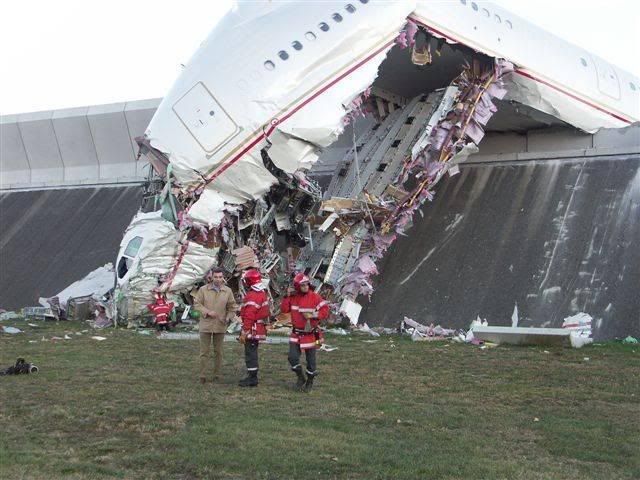
The ADAT crew had no idea that this is a safety feature so that pilots can't land with the brakes on. Not one member of the seven-man Arab crew was smart enough to throttle back the engines from their max power setting, so the $200 million brand-new aircraft crashed into a blast barrier, totaling it. The extent of injuries to the crew is unknown, for there has been a news blackout in the major media in France and elsewhere. Coverage of the story was deemed insulting to Moslem Arabs.


PostPosted: Wed Sep 24, 2008 4:10 pm
by travnz
FAIL

PostPosted: Wed Sep 24, 2008 5:12 pm
by Njbb1995
Oh that wooda hurt ohmy.gif

PostPosted: Wed Sep 24, 2008 5:40 pm
by TimG
I wouldn't expect the crew to be in very good condition. It looks like they hit the barrier at quite a fast speed. I hope they were wearing their seatbelts.

PostPosted: Wed Sep 24, 2008 5:45 pm
by waka172rg
Be good to get the cockpit voice recorder see what was said!!
the last pic looks like the Concorde with is nose down for landing haha
i wonder if insurance will cover that unsure.gif

PostPosted: Wed Sep 24, 2008 5:49 pm
by Charl
The crew were stationary, with respect to the outside surroundings...
The faster the 'Bus went forward, the harder they ran - backward.
By the time the aircarft came to a standstill, they had reached the rear exit.
Not for nothing is the A340-600 the longest aircraft in the skies. biggrin.gif
Hadn't seen the last 2 pics before, it really is broken.
Hope the Bank Draft had gone through...

PostPosted: Wed Sep 24, 2008 6:03 pm
by PiperDriver
Only 200 million for a new plane.....

PostPosted: Wed Sep 24, 2008 7:19 pm
by Njbb1995
Yea only.....

PostPosted: Wed Sep 24, 2008 7:24 pm
by Alex
Not new news though, I remember hearing about this ages ago...

Almost a case of too many computers for good sense. dry.gif

Alex

PostPosted: Wed Sep 24, 2008 8:17 pm
by FlyingKiwi

PostPosted: Wed Sep 24, 2008 8:33 pm
by deaneb
Alex wrote:
QUOTE (Alex @ Sep 24 2008, 07:24 PM) <{POST_SNAPBACK}>
Almost a case of too many computers for good sense. dry.gif

Alex


Nope - just a case of people out of their depth. I just left after a 22 year engineering career in the RNZAF and was qualified to conduct ground runs in various aircarft types. I'm not going to spell out the need for qualification and training, but at the very least if you don't know how to shut down engines quickly in an emergency situation you have no place to be in the cockpit.

This also happened to an Canadian Forces Airbus in Canada - ploughed into a hangar and the snow laden roof collapsed on top of it.

Deane

PostPosted: Thu Sep 25, 2008 1:49 am
by Ian Warren
Moslem Arabs.....ooooh Jolly blimey biggrin.gif .. Its an oldie .. but a goodie .......... looking at the state of it , it gives all a good idea just how fragile they are

PostPosted: Thu Sep 25, 2008 10:25 am
by bestpilotindaworld
Classic laugh.gif

PostPosted: Thu Sep 25, 2008 11:20 am
by Ian Warren
You did,nt see what the ETIHAD Arab boss's said to the flight crew
ينقلك زر ضربة حظّ "ضربة حظ ن استخدام زر ضربة حظّ "ضربة حظ" يعني وقت بحث أقل ووقت أطول للمطالعة .تلقائياً إلى أول صفحة ويب في نتائج البحث.
إ ohmy.gif
roughly translated :
Arch Doh ! may the fleas of a thousand camels nest under your arm pits ....... Doh ..shazbolt!

plane.gif

PostPosted: Thu Dec 11, 2008 11:40 am
by Chairman
deaneb wrote:
QUOTE (deaneb @ Sep 24 2008, 09:33 PM) <{POST_SNAPBACK}>
I'm not going to spell out the need for qualification and training, but at the very least if you don't know how to shut down engines quickly in an emergency situation you have no place to be in the cockpit.


The fact that you're trained in how to do it doesn't mean you're going to remember to do it blink.gif

The accident investigation report has been released ...

Violation of test procedures led to Toulouse A340-600 crash
By David Kaminski-Morrow

Investigators have determined that an Airbus A340-600 collided with a test-pen wall in Toulouse after it was powered up while unchocked, and an attempt to steer the aircraft out of danger reduced the effect of the brakes.

The test crew failed to reduce the engine thrust as the jet surged forward, attempting instead to stop the aircraft by pressing the brake pedals and turning the nose-wheel sharply to the right. It smashed into the pen wall, seriously injuring four of the nine people on board.

A division of the French Bureau d'Enquetes et d'Analyses, which conducted the inquiry, has released its final report into the accident, stating that "lack of detection and correction" of test-procedure violations helped lead to the accident.

It points out that procedures for the test, aimed at checking for oil leaks, were not correctly followed, noting that the engines were all operating at high power and the aircraft was left unchocked.

Detailing the events leading to the collision, it says the aircraft arrived in the test-pen at 14:19 on 15 November last year and underwent routine engine tests for about 1hr 40min.

Just before 16:00 the power of the Rolls-Royce Trent 500 engines was increased to an engine pressure ratio of 1.25 - with the thrust levers corresponding to a position between maximum continuous thrust and maximum take-off thrust.

All four engines were operating. While the parking brake was on, registering 2,600psi, the inquiry says the applied thrust was around the limit of the parking-brake capacity.

At the time of the accident an Airbus employee was occupying the right-hand seat of the jet while an Abu Dhabi Aircraft Technologies technician was in the left-hand seat.

Flight-recorder data shows that, shortly after 16:02, the person in the left-hand seat warned that the aircraft was moving. The ground speed began gradually increasing to 4kt over the next few seconds and, after a second call that the aircraft was moving, the recorder registered pedal-braking and the deactivation of the parking brake.

Brakes on the A340-600 are linked to two hydraulic circuits: the 'green' normal circuit and the 'blue' alternate. The parking brake is on the blue circuit and only applies to the left- and right-hand main undercarriage bogies, not the centre bogie.

If the parking brake is released and the brake pedals applied, the 'green' circuit comes into play. The pedals act on all three main bogies.

Recorder data shows that 'green' circuit brake pressure on the A340 rapidly rose to 2,500psi while the 'blue' circuit pressure dropped.

About seven seconds after the first movement warning the nose-wheel was turned sharply right. Activating the nose-wheel steering inhibits braking on the central bogie, becoming completely ineffective past 20° of steering.

The aircraft swung 37° to the right but continued to accelerate, its speed increasing from 4kt to 31kt in seven seconds, before the aircraft struck the test-pen wall, demolishing its forward fuselage. The jet was written off.

In its report into the accident, the BEA says the aircraft and its braking system functioned correctly, but states that the nose-wheel steering "limited the effectiveness" of the brakes.

"Surprise led the ground-test technician to focus on the braking system, so he did not think about reducing the engines' thrust," it adds. Only after the collision with the wall were the throttle levers retarded to the idle position.

PostPosted: Thu Dec 11, 2008 12:40 pm
by bestpilotindaworld
What a tool notworthy.gif

PostPosted: Thu Dec 11, 2008 12:45 pm
by Charl
See, when you apply max brakes on a camel, it automatically goes out of charge forward flat out mode.
The same does not apply to Airbus aircraft, it would seem.
You'd imagine the chaps at Toulouse would be looking into the logic circuits around now...

PostPosted: Thu Dec 11, 2008 1:15 pm
by Ian Warren
Charl wrote:
QUOTE (Charl @ Dec 11 2008, 01:45 PM) <{POST_SNAPBACK}>
You'd imagine the chaps at Toulouse would be looking into the ....

.... Concrete wall and remove it before ... before ... oh yeah , a man smoking a Camel cigarette choked knocked the parking brake listen to some music blink.gif WHOOPS ! I did it again laugh.gif

PostPosted: Thu Dec 11, 2008 6:37 pm
by deaneb
Chairman wrote:
QUOTE (Chairman @ Dec 11 2008, 12:40 PM) <{POST_SNAPBACK}>
The fact that you're trained in how to do it doesn't mean you're going to remember to do it blink.gif


Just reinforces my statement - they were not competent enough to be in the cockpit. Sliding on the brakes was always a big fear of mine and we were constantly alert of the possibility, so I always had it in the back of my mind. At night in the wet, with light fuel an Orion could slide 10m before you knew it and we never took more than two engines up to high power at a time. Luckily it never happened to me, but it does happen. Reducing the power should be instinctive, especially if you have good training.

PostPosted: Thu Dec 11, 2008 7:20 pm
by chickenman
deaneb wrote:
QUOTE (deaneb @ Dec 11 2008, 07:37 PM) <{POST_SNAPBACK}>
especially if you have good training.


I think you hit the nail on the head Deane, in this case it had to be a major part of the incident since there were nine people on board. I don't know how many were on the flight deck but if there was more than two of them it has to be something pretty systemic. There were clearly at least two in the seats.

Mind you having seen that I saw a guy accidentially let the hand brake off his ford falcon. He was in the drivers seat and he got out and tried to stop the car from sliding into the waitaki river by holding on to it and doing some crazy arse superman shite! What I'm trying to say is that when stupid people panic stupid things happen, no matter how rational the solution actually is.