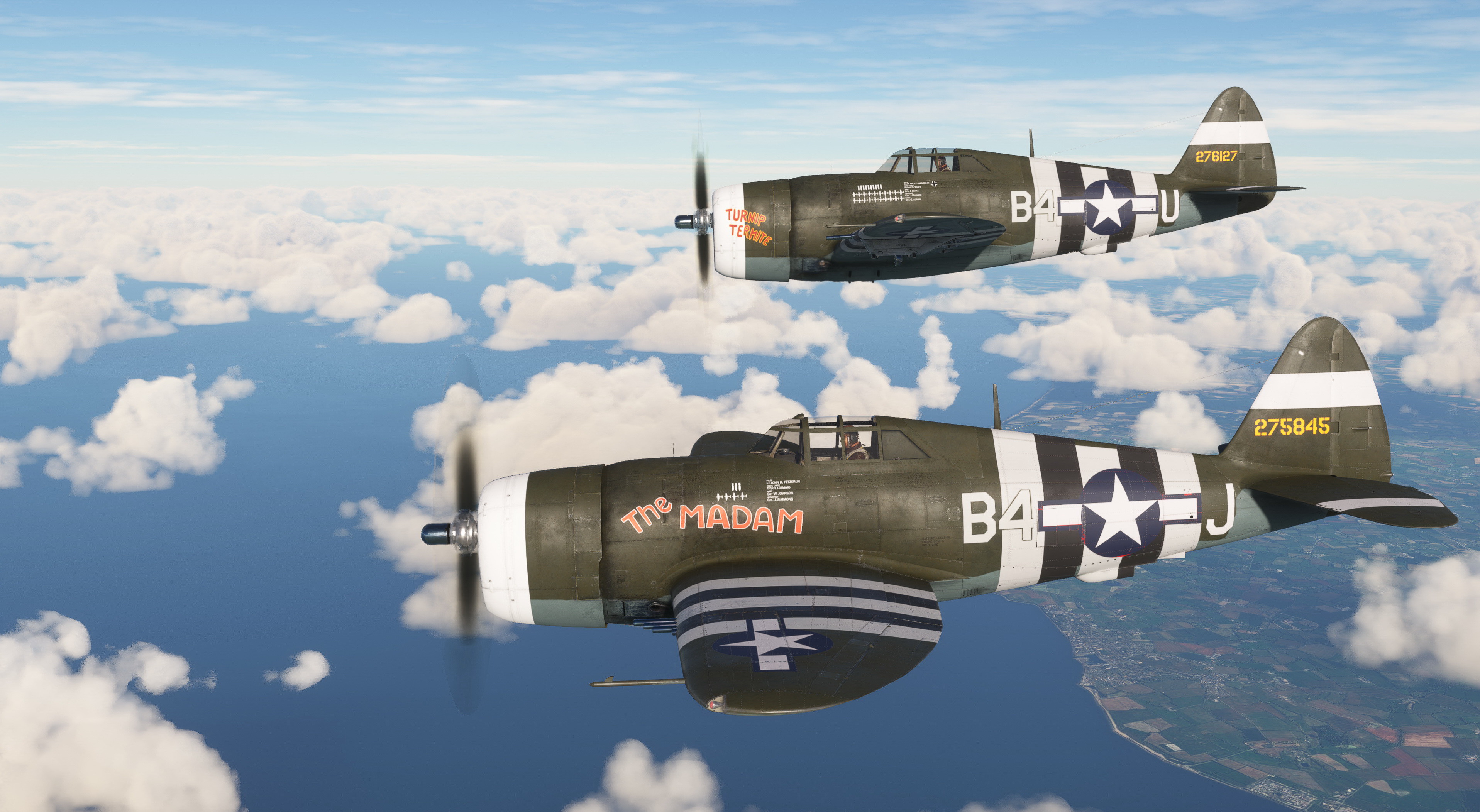
P-47D-15-RE 42-75845 B4-J "The Madam". It was the assigned aircraft of Lieutenant John H. Fetzer, from Shreveport Louisiana, of the 387th FS/ 365th FG during D-Day. He was flying as wingman of Capt. Arlo Henry on 6 June 1944, D-Day, when they spotted a number of Tiger tanks trying to hide in a castle. Capt Henry blew up the castle with his bombs, while Lt Fetzer attacked a Tiger with his 1000 lb bombs. His first bomb exploded harmlessly in a field, but his second "my contribution to D-Day" exploded right behind the Tiger, flipping it over 3 times. As for 42-75845, she proved to be a very strong lady. It began its career with the initial start of operations of the 365h FG, with Lt. Fetzer as its original pilot. He named the aircraft after his future wife, Helen. It flew its 200th mission in March 1945, and continued right to the end of the war, as the only remaining original Thunderbolt of the 365th. She was shot up several times, had wings and engines replaced and countless holes patched, but its crew chief, Joe DiMaio remarked that as long as 'the Madam' came back, he would keep her flying, and he did.
 madam (0001)
 by
JanKees Blom, on Flickr
P-47D-15-RE 42-76127 B4-U "Turnip Termite". It was the assigned aircraft of Captain Arlo Henry, of Dearborn, Michigan, of the 387th FS/ 365th FG. He had touched the ground with his prop on one of his earlier missions and the ground recovered from his engine on that occasion gave rise to the name 'Turnip Termite' for his aircraft. On 7 June 1944, Lt Joseph Miller was flying Henry's B4-U over Normandy when he thought he was low on fuel and could not reach the base in England anymore. He bellied in near Omaha Beach in a minefield, and he had to walk out through the fresh furrow created by his aircraft. 'Turnip Termite' was recovered, but was consigned to be salvaged. The cowling panels with the name were used on later versions of Capt. Henry's 'Turnip termite'.
 madam (0002)
 by
JanKees Blom, on Flickr
 madam (0007)
 by
JanKees Blom, on Flickr

