Timmo wrote:QUOTE (Timmo @ Nov 1 2007, 10:52 AM) <{POST_SNAPBACK}>I think it would have been better to use a single turbine helo (As350, Ec120?)
The final 2 up for offer was the A109 and the mil version (can't think of the name) of the Ec135Timmo wrote:QUOTE (Timmo @ Nov 1 2007, 10:52 AM) <{POST_SNAPBACK}>"The bigger a helicopter is the easier it is to fly them"- Cant say I agree with that...different but not easier.
Same here.
I see the USAF's (or the army, cant remember) primary chopper trainer is the Bell TH-67 (mil jetranger). I know a falla who has a jetranger and he learnt to fly that (as apposed to a robbie or 300) after a couple thousand hours fixed wing and he said that was even tough
A185F- Sim-holic
- Joined: Sun Mar 04, 2007 9:25 pm
- Posts: 613
- Location: right behind my laptop
New RNZAF Training Helo
27 posts
• Page 2 of 2 • 1, 2
 by A185F » Thu Nov 01, 2007 10:57 am

by Naki » Thu Nov 01, 2007 11:43 am
Yes I can see where you guys are coming from but if you read the tender specs below there was only one helicopter that met the specs - the A109. The Air Force specified a wheeled (ie ship deck operations), twin engine helicopter of about 3 tonnes. There is also a sim specified as part of the package therefore reducing actual flying training hours:
New Zealand Ministry of Defence
REQUEST FOR TENDER
TRAINING/LIGHT UTILITY HELICOPTER (T/LUH) CAPABILITY
The Ministry of Defence is managing a project to acquire a Training/Light Utility Helicopter (T/LUH) that will be employed more
broadly than as a basic training helicopter. The T/LUH will support the NH90 in the conduct of counter-terrorist or police operations. The T/LUH will also provide helicopter ab-initio and advanced helicopter pilot training, Qualified Helicopter Instructor training as well as providing a full range of crewman training tasks.
The Crown's intention is to seek capability solutions that minimise procurement costs by maximising "off the shelf' content and limiting non-recurring engineering costs, without unduly constraining a Respondents ability to offer innovative solutions.
Specifically, the T/LUH must be currently in production and have twin engines with Full Authority Digital Engine Control, a fully integrated digital cockpit utilising multi-function displays, a Flight Management System, an advanced autopilot and be capable of certification to FAR/JAR Part 27 or equivalent military standards. The helicopter must embody a secure military communications suite. The helicopter must be suitable for training pilots and aircrewmen in all day and night VFR and IFR operations including; the use of night vision goggles, the conduct of winching and the carriage of underslung loads.
The Crown has a preference for a T/LUH with a retractable wheeled undercarriage for a range of training and risk mitigation reasons,
including deck operations and conformity of lead-in training to the NH90 and SH-2G Seasprite, as well as to provide some growth potential for future maritime light utility tasks. It is envisaged that the T/LUH, at Maximum All Up Weight, will be in the 3-tonne class. The delivery of a suitable Flight Training Device is an integral requirement of the project.
The project involves the manufacture and delivery of a Training/Light Utility Helicopter and the provision of a Flight Training Device along with appropriate technical and integrated logistic support for both.
The Ministry invites companies that: have an in-production T/LUH which meets the specific capability requirements detailed in the Request For Tender (RFT) documentation; can facilitate the delivery of an appropriate Flight Training Device; and that have the skills, experience, resources and capabilities to undertake such a project, to tender for the provision of a Training/Light Utility Helicopter capability to the Crown.
The purpose of the Request For Tender is:
(a) to seek tenders in order to assess which respondents have both an in-production helicopter that meets the requirements detailed in the RFT documentation and the requisite skills, experience, resources and capabilities to provide a T/LUH capability;
(b) to allow the Ministry to conduct a competitive "value for money' comparison between submitted tenders; and
© to allow the Ministry to identify and select those respondents to whom it will issue a best and final offer or contract proposal.
Prospective respondents should contact WGCDR Barry Nelson via email at the address below, requesting a copy of the RFT documentation. Documents will be supplied by return email and will include both PDFâ„¢ and MS Excelâ„¢ files. Hard copy documents will be provided if specifically requested, noting that both hard and electronic copies of responses will be required in due course.
Any other queries should be addressed to:
Project Team Leader (T/LUH)
Acquisition Division, Ministry of Defence
PO Box 5347, Lambton Quay
Wellington, NEW ZEALAND
Email: barry.nelson@defence.govt.nz Fax: +64 4 4960858
The Request For Tender for the Training/Light Utility Helicopter Capability Project closes at 12 noon (New Zealand Daylight
Time) on Monday, 15 January 2007
New Zealand Ministry of Defence
REQUEST FOR TENDER
TRAINING/LIGHT UTILITY HELICOPTER (T/LUH) CAPABILITY
The Ministry of Defence is managing a project to acquire a Training/Light Utility Helicopter (T/LUH) that will be employed more
broadly than as a basic training helicopter. The T/LUH will support the NH90 in the conduct of counter-terrorist or police operations. The T/LUH will also provide helicopter ab-initio and advanced helicopter pilot training, Qualified Helicopter Instructor training as well as providing a full range of crewman training tasks.
The Crown's intention is to seek capability solutions that minimise procurement costs by maximising "off the shelf' content and limiting non-recurring engineering costs, without unduly constraining a Respondents ability to offer innovative solutions.
Specifically, the T/LUH must be currently in production and have twin engines with Full Authority Digital Engine Control, a fully integrated digital cockpit utilising multi-function displays, a Flight Management System, an advanced autopilot and be capable of certification to FAR/JAR Part 27 or equivalent military standards. The helicopter must embody a secure military communications suite. The helicopter must be suitable for training pilots and aircrewmen in all day and night VFR and IFR operations including; the use of night vision goggles, the conduct of winching and the carriage of underslung loads.
The Crown has a preference for a T/LUH with a retractable wheeled undercarriage for a range of training and risk mitigation reasons,
including deck operations and conformity of lead-in training to the NH90 and SH-2G Seasprite, as well as to provide some growth potential for future maritime light utility tasks. It is envisaged that the T/LUH, at Maximum All Up Weight, will be in the 3-tonne class. The delivery of a suitable Flight Training Device is an integral requirement of the project.
The project involves the manufacture and delivery of a Training/Light Utility Helicopter and the provision of a Flight Training Device along with appropriate technical and integrated logistic support for both.
The Ministry invites companies that: have an in-production T/LUH which meets the specific capability requirements detailed in the Request For Tender (RFT) documentation; can facilitate the delivery of an appropriate Flight Training Device; and that have the skills, experience, resources and capabilities to undertake such a project, to tender for the provision of a Training/Light Utility Helicopter capability to the Crown.
The purpose of the Request For Tender is:
(a) to seek tenders in order to assess which respondents have both an in-production helicopter that meets the requirements detailed in the RFT documentation and the requisite skills, experience, resources and capabilities to provide a T/LUH capability;
(b) to allow the Ministry to conduct a competitive "value for money' comparison between submitted tenders; and
© to allow the Ministry to identify and select those respondents to whom it will issue a best and final offer or contract proposal.
Prospective respondents should contact WGCDR Barry Nelson via email at the address below, requesting a copy of the RFT documentation. Documents will be supplied by return email and will include both PDFâ„¢ and MS Excelâ„¢ files. Hard copy documents will be provided if specifically requested, noting that both hard and electronic copies of responses will be required in due course.
Any other queries should be addressed to:
Project Team Leader (T/LUH)
Acquisition Division, Ministry of Defence
PO Box 5347, Lambton Quay
Wellington, NEW ZEALAND
Email: barry.nelson@defence.govt.nz Fax: +64 4 4960858
The Request For Tender for the Training/Light Utility Helicopter Capability Project closes at 12 noon (New Zealand Daylight
Time) on Monday, 15 January 2007
Last edited by Naki on Thu Nov 01, 2007 12:30 pm, edited 1 time in total.
-

Naki - NZFF Pro
- Joined: Sat Aug 05, 2006 10:03 pm
- Posts: 7170
- Location: Tauranga


by redkiwi » Wed Jan 16, 2008 1:01 pm
Mad? Because they chose an aircraft that can fulfill multiple roles, and still be a valuable training asset?
The reason civilian pilots train on a R22 or similar is one thing, price - at nearly $400/hr in most helos it makes training costs horrendous - i'd hate to think what it costs to train to fly in a Bell 206, and personally wouldn't like to pay for it on a student loan or out of my own pocket.
As Naki posted - its a light utility helicopter, and one of it's roles is training. It's not a training helicopter that will be used for other tasks, though I guess the flying hour distribution will say different.
Tougher training will only yeild better results - only the best will make it through. I'd rather have a bunch of dedicate and highly skilled pilots flying decent aircraft as opposed to many crews that aren't quite as good.
The reason civilian pilots train on a R22 or similar is one thing, price - at nearly $400/hr in most helos it makes training costs horrendous - i'd hate to think what it costs to train to fly in a Bell 206, and personally wouldn't like to pay for it on a student loan or out of my own pocket.
As Naki posted - its a light utility helicopter, and one of it's roles is training. It's not a training helicopter that will be used for other tasks, though I guess the flying hour distribution will say different.
Tougher training will only yeild better results - only the best will make it through. I'd rather have a bunch of dedicate and highly skilled pilots flying decent aircraft as opposed to many crews that aren't quite as good.
- redkiwi
- Forum Addict
- Joined: Mon Jan 14, 2008 4:11 pm
- Posts: 193
by atc_unit » Thu Jan 17, 2008 1:19 am
redkiwi wrote:QUOTE (redkiwi @ Jan 21 2008, 01:01 AM) <{POST_SNAPBACK}>The reason civilian pilots train on a R22 or similar is one thing, price - at nearly $400/hr in most helos it makes training costs horrendous - i'd hate to think what it costs to train to fly in a Bell 206, and personally wouldn't like to pay for it on a student loan or out of my own pocket.
The R22 is said to be one of the more difficult helicopters to fly as well, something about stability and the like. A couple of my mates have said that learning to fly in a R22 was a steap learning curve, they now flying Jet Rangers and H500's and said its too easySomething tells me they just talking it up - like most chopper pilots *ducks*
Leon Gibbs
VATNZ Deputy Director
NZ CPL(A)+MEIR, B-Cat
Stewart Island Flights - IVC

-
atc_unit - Member
- Joined: Sat Nov 18, 2006 4:09 pm
- Posts: 34
- Location: Invercargill, NZ
by 2fst4u » Tue Jan 22, 2008 2:32 pm
atc_unit wrote:QUOTE (atc_unit @ Jan 17 2008, 02:19 AM) <{POST_SNAPBACK}>The R22 is said to be one of the more difficult helicopters to fly as well, something about stability and the like. A couple of my mates have said that learning to fly in a R22 was a steap learning curve, they now flying Jet Rangers and H500's and said its too easy
it's true. i dont know from experience but r22's are used as first helos to train on because they suck. my instuctor last time said that once you master the r22, you can fly anything.
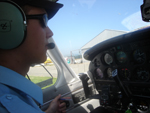
and also, why are you flying/sitting in cockpit in uniform? and why does your uniform have no rank slides?
- 2fst4u
- Forum Addict
- Joined: Fri Dec 07, 2007 3:27 pm
- Posts: 388
- Location: Wellington, New Zealand
by Timmo » Tue Jan 22, 2008 4:18 pm
The R22 is a very 'light' helicopter to fly. It has a very low inertia rotor which changes speed very quickly. This makes it nice and responsive but also prone to dangerously low rotor RPM if the engine quits etc. For example, compare/imagine how easy it is to stop one of those personal cooling fans with a plastic blade compared to if you added a heavier metal blade (i.e. Stop it with your finger vs Dont stop it with your finger  . The lighter plastic blade would accelerate to full speed faster but would also decelerate just as fast. The heavier metal blade would acclerate to full speed slower but would also decelerate slower. So, if the engine quits on a helo with a heavier/higher intertia rotor system, the pilot has more time to drop the collective and set up for autorotation. On an R22, its literally a second or two difference between recognising low rotor RPM/Engine failure and dropping the collective in time (i.e. live......maybe), or not and stalling the rotor (i.e. die)
I guess it is a bit like driving a sports car- Twitchy and precise but fun when you have mastered it.
As a comparison ive also flown a S300/H269 which is of similar size but with a three blade rotor. This seemed far more 'stable' and with nice, heavier feedback through the stick....I found it far easier trying to hover in this than in the R22 (but im not sure how much of that could be the fact that when I flew in the R22, it was my first time in a helo)
. The lighter plastic blade would accelerate to full speed faster but would also decelerate just as fast. The heavier metal blade would acclerate to full speed slower but would also decelerate slower. So, if the engine quits on a helo with a heavier/higher intertia rotor system, the pilot has more time to drop the collective and set up for autorotation. On an R22, its literally a second or two difference between recognising low rotor RPM/Engine failure and dropping the collective in time (i.e. live......maybe), or not and stalling the rotor (i.e. die)I guess it is a bit like driving a sports car- Twitchy and precise but fun when you have mastered it.
As a comparison ive also flown a S300/H269 which is of similar size but with a three blade rotor. This seemed far more 'stable' and with nice, heavier feedback through the stick....I found it far easier trying to hover in this than in the R22 (but im not sure how much of that could be the fact that when I flew in the R22, it was my first time in a helo)
- Timmo
- NZFF Pro
- Joined: Wed Oct 25, 2006 6:28 pm
- Posts: 2056
- Location: Tauranga
27 posts
• Page 2 of 2 • 1, 2
Return to New Zealand Aviation
Who is online
Users browsing this forum: No registered users and 23 guests